Showing posts with label IL-33. Show all posts

Tuesday, March 20, 2018

IL-33 is a natural target of allergen proteases

IL-33 is a member of IL-1 family and requires proteolytic cleavage to form active form. It has already been linked to allergy manifestation. Now, new study in nature immunology expands on earlier observations to show that full-length non-active IL-33 (IL-33FL) is a natural target of group of allergens with proteases activity.

In general, many known allergens display protease activity such as from fungi, mites, pollens, insects. Co-incubation of IL-33FL with such allergen proteases in presence of innate lymphoid cells type II (ILC2) generated biologically-active smaller fragments and release of type II cytokines.


IL-33FL is an intra-nuclear proto-chemokine found in epithelial and endothelial cells. So, how allergens get access to it? It requires cell damage to release IL-33FL extra-cellularly. However, it is not clear if any allergen proteases can damage cells. At least one such allergen from fungus, Alternaria alternata (A. alternata) can damage cell and then cleave IL-33FL.


Similar effects were seen in vivo using IL-33KO mice. In these mice, recruitment of eosinophils, a readout for IL-33-driven allergic response, were only observed when injected with pre-incubated IL-33FL and A. alternata mixture.


In summary, these results suggest that allergen from A. alternata with protease activity can damage cells to release IL-33FL and cleave it into biologically-active shorter peptides. However, this study did not show that other allergens can deliver similar double punch. Also, it is not clear how this innate mechanism translates to adaptive immune system to generate allergen-specific T cell and antibody responses.

posted by David Usharauli


Thursday, February 16, 2017

IL-33 → MyD88 pathway drives type II immunity in female genital mucosa

Type II immunity underlies several types of immune conditions such as asthma, allergy or response to parasitic helminths. It is not yet fully clear how type II immunity contributes to host's defenses. At this stage scientific inquiry is mostly focused on uncovering cellular and molecular mechanism behind type II immunity.


For these experiments the authors have used papain, a well established experimental type II inducer protease. As reported before, papain required enzymatic activity for its type II response.


Papain application to female vaginal mucosa induced IL-33, a member of IL-1 family implicated in type II immunity.


Indeed, IL-33 deficient mice showed reduced secretion of components of type II immunity (IL-4, IgE).


Interestingly, type II immunity in response to papain in female genital tract depended on IRF4+ CD11c+ dendritic cells but it was independent of basophils and eosinophils.


Furthermore, type II immunity in response to papain application to female vaginal tissue depended on MyD88 signaling.  


In summary, this study confirms the role of IL-33 in type II immunity.

David Usharauli


Tuesday, October 18, 2016

Bifurcation of type 2 immunity

Type II immunity is referred to a Th2 dominant immune response to a wide array of proteases, venoms and mechanical irritants. Both innate ILC2 cells as well as adaptive Th2 cells are involved in this process. The relationship between innate and adaptive components of type II immunity is still being defined.


For example, the authors showed that parasitic nematode Nippostrongylus brasiliensis (Nb)-infected mice triple deficient in sensing of TSLP, IL-25 and IL-33, the epithelial cytokines which have been linked to Th2 cell function, have normal lymph node IL-4+ Th2 differentiation and IgE production, but significantly diminished potential to secrete IL-13 and IL-5, effector Th2 cytokines, in the periphery. 


Importantly, such bifurcation of Th2 effector functionality was T cell intrinsic by sensing locally produced "release" cytokines, TSLP, IL-25 and IL-33.


In summary, this study indicate that even at the level of Th2 cells their effector functionality could be bifurcated depending on the local tissue micro-environment. This concept is important to better understand how to treat different types of allergies, for example, IL-4/IgE dominant systemic allergies versus IL-5/IL-13 dominant local tissue chronic allergies.     

David Usharauli

Wednesday, July 13, 2016

ILC2 sustain antigen-independent allergic responses

Most allergies represent exaggerated type II immune responses driven by adaptive Th2 cells. At least, this is what we used to believe it. However, discovery of rare innate cells, referred as innate lymphoid cells (ILCs), is slowly changing our understanding of cellular responses underlying allergies.

It is clear now that in laboratory mice model of allergy, type 2 ILCs (ILC2) contribute significantly and non-specifically [it seems] in sustaining allergy to irritant-allergens.


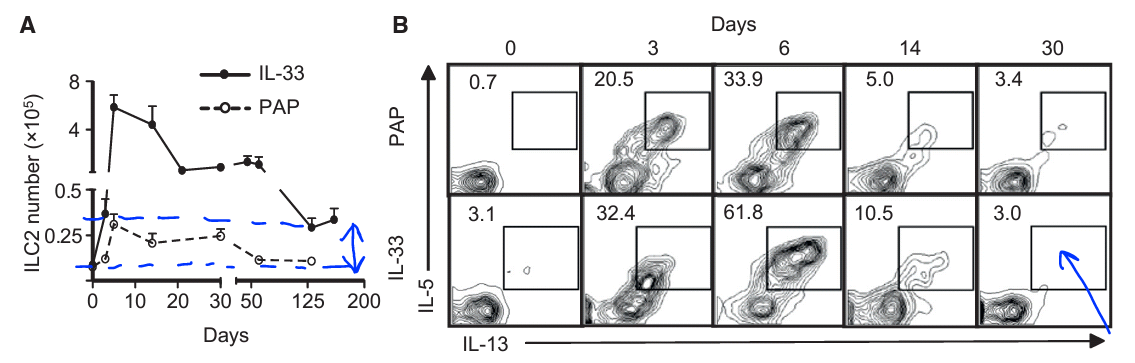
When analyzed ILC2 response to IL-33 or papain in lung tissue, the authors found that ILC2 displayed a typical adaptive-like behavior (expansion, contraction, quiescence).


Importantly, when IL-33 primed mice were challenged with allergen one month later ILC2 showed heighten type II response to allergen (papain) but not to control (saline). This response was "allergen"[protease]-specific but antigen-independent. It is possible that primed ILC2 were responding to IL-33 [or IL-25] released during papain challenge.


Similar data were obtained from mice primed with fungal Aspergillus protease (ASP) allergen and challenged 3.5 months later with papain (but not to saline). Here too, primed ILC2 could be responding [indirectly] to IL-33 or IL-25 released by papain.


In summary, this study showed that at least in mice "primed" innate lymphoid cells retain "heightened" non-specific responsiveness to allergen "long-term" (up to 6 months). This could explain why adaptive TH2 cell targeting immunotherapies may not be fully successful because it ignores contributions from innate cells such as ILC2.

David Usharauli


Saturday, March 26, 2016

Papain protease activity and mast cells, but not IL-33, are necessary for papain allergic sensitization

Papain is a proteolytic enzyme from papaya. Like other protease allergens such house dust mites (HDM) group 1 allergen, Der p 1, papain is allergen that belongs to family of cysteine proteases. Papain can induce skin contact sensitization or airway hyper-reactivity. 


When injected in mouse ear lobes, intact papain, but not protease-inactive papain (E64-papain), induced skin inflammation and IgE production.


Papain induced IgE production after skin challenge depended on presence of functional mast cells as (a) such response was diminished in mast cell–deficient WBB6F1-W/Wv (W/Wv) mice, and (b) such response could be recovered after transfer of WT mast cells. 


However, unlike mast cells, IL-33 was dispensable for IgE production after papain skin [primary] challenge (though IL-33 played the role in lung eosinophil infiltration later on, upon airway re-challenge with intact papain).


In summary, this study indicate that initial skin sensitization with papain required mast cells but not proto-TH2 innate "primer" cytokine IL-33. This knowledge should be incorporated in therapeutic strategies targeting IL-33 pathway (IL-33 and its receptor ST2).

David Usharauli


Thursday, February 11, 2016

Flexing muscles with IL-33 responsive Tregs

Just read another paper about Foxp3+ Tregs published in journal Immunity. Not clear what to make out of it. It came from Christophe Benoist and Diane Mathis lab, both wellknown immunologists, but it feels if it was done by non-immunologist. It does have Amy J. Wagers as a co-authors. She is known for her studies of stem cells.


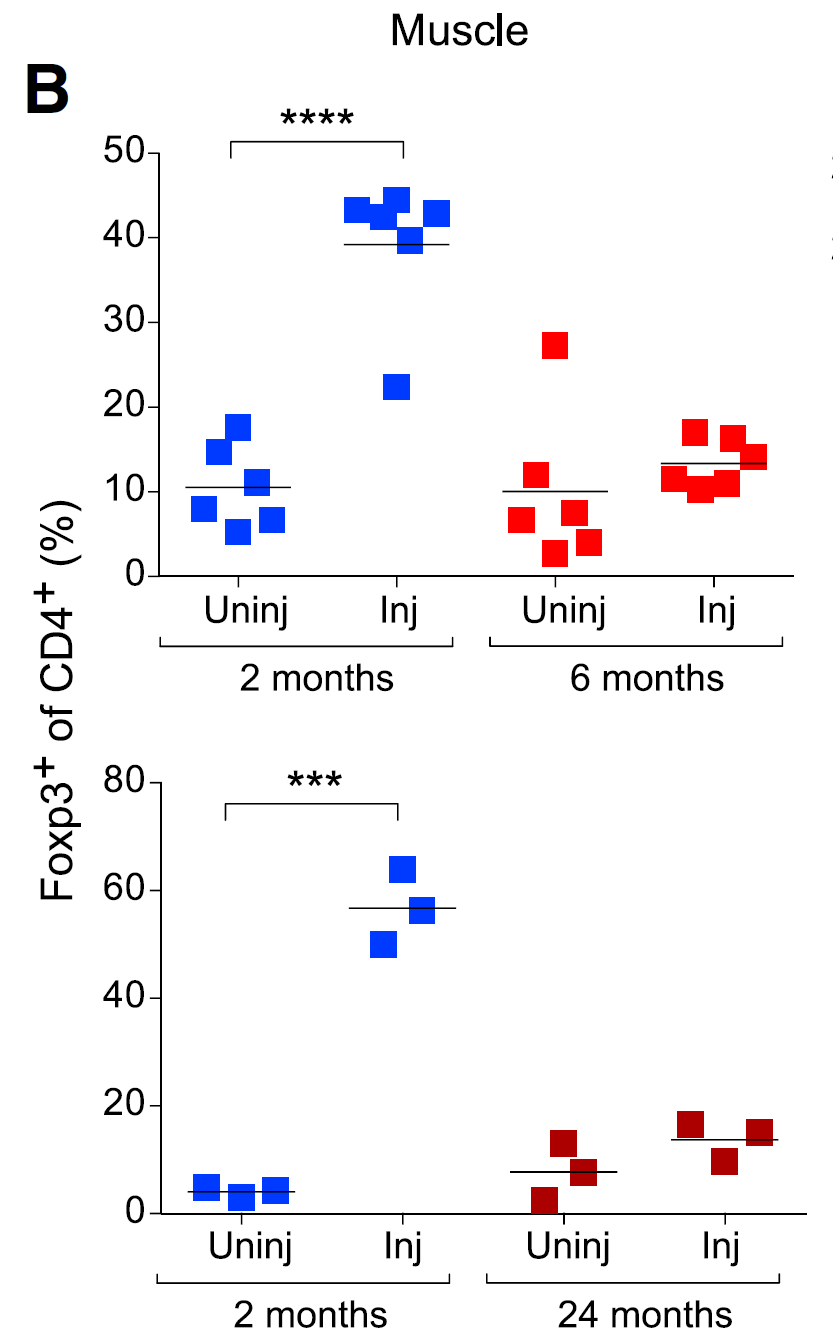
Now, how does one test this hypothesis? I will highlight what is good in this paper and what is missing. Initially, the authors showed that in old mice muscle injury (cryo-injury or by toxin) does not attracts as much Tregs as in young mice. Strangely, Tregs recruitment within injured muscle tissue was examined using anti-Foxp3 antibody rather more widely accepted model of Foxp3 reporter mice [which they indicated in methods section they had].


Next, the authors found that cytokine IL-33 was up-regulated in injured muscle tissue (young mouse).


Correspondingly, Tregs recruited and enriched within injured muscle tissue expressed IL-33 receptor called ST2.


Next, the authors speculated that there was maybe some connection between IL-33 responsive Tregs (ST+ Tregs) and muscle regeneration. Indeed, when they have repeated the same experiment with mice deficient for IL-33 receptor specifically on Tregs, muscle regeneration were impaired [after injury]. Though the authors did not show data whether there was no difference between muscle regeneration between young and old mice when both were deficient for IL-33 receptor specifically on Tregs. Without such data it is not possible to conclude whether difference in IL-33 responsiveness in Tregs accounts for difference between young and old mice with respect to muscle regeneration.  
  

Analysis of IL-33 producing cell within muscle tissue showed that fibro/adipogenic progenitor (FAP) cells were the main producer of muscle IL-33 and they produced less of IL-33 after muscle injury in old mice.

Finally, injection of IL-33 into old mice muscle improved its regenerative potential after injury (however, the authors did not repeat the same experiment with Treg-specific IL-33 receptor deficient mice to formally confirm that beneficial effect of exogenous IL-33 was indeed mediated via Tregs).


In summary, this study suggests that IL-33 improves muscle regeneration, in general. Whether reduced number of IL-33 responsive Tregs in old mice represents only variable between young or old mice with respect of muscle regeneration is not clear from this paper. Basically, In my opinion, the results do not support the paper's conclusions with respect to Tregs.

David Usharauli

Wednesday, September 2, 2015

Adaptive Th2 cells can double as innate cells during allergy and helminth infection

Antigen specificity is a dominant feature of adaptive immune system. However, on occasions, fully differentiated effector T cells do show TCR-independent responsiveness to cytokines. Whether this is a good or bad thing is not easy to tell. 


For this study the authors had used a dual-reporter mouse model, called 4C13R, where both cytokine IL-4 and IL-13 are genetically labeled. Initially, the authors showed that adoptively transferred in vitro differentiated Th2 OT-II transgenic T cells, on 4C13R background, could secrete IL-13 (but not IL-4) in response to cytokine IL-33 (in combination with STAT5 activator IL-7 or TSLP).


Similarly, the authors observed TCR-independent IL-13 secretion by in vivo differentiated Th2 OT-II 4C13R cells to a Papain challenge (Papain is a protease and has been shown to induce type II immune response).


This TCR-independent secretion of IL-13 by differentiated Th2 cells was driven by IL-33.


Since type 2 innate lymphoid cells (ILC2) are known to respond to IL-33, the authors analyzed secretion of IL-13 by both Th2 and ILC cells after Papain challenge (here, mice were initially exposed to N. brasiliensis, a type II activator helminth). Both population could respond to Papain by secreting IL-13 (but not IL-4).


Similar results were obtained with another allergen, house dust mite extract (HDM).


Further experiments with RAG2-IL-2Rγ DKO hosts, which lack endogenous T and ILC2 cells, revealed that adoptive transfer of in vitro differentiated Th2 cells was sufficient to induce eosinophilia in lung tissue upon HDM exposure (allergen exposure).


The authors reasoned that in physiological situations initial antigenic priming would increase the number of Th2 cells to the level comparable to that of ILC2 and this would play a significant role in host protection or response to type II irritants (worm or allergen). Indeed, the authors showed that Th2 cells developed after first helminth infection could provide partial host protection to a second helminth infection, even in absence of ILC2 cells (in RORα bone marrow chimera).


In summary, these results suggest that adaptive immune cells can take the function of innate cells when necessary. Here, IL-13 appears to be a dominant cytokine that drives type II immune effector function (in 1990s ad early 2000s, the prevalent hypothesis positioned IL-4 in the center of type II immune effector response).

Such TCR-independent responsiveness has important implications for treatments of type II immune disorders such as allergy or dermatitis. For example, antigen (TCR ligand) desensitization protocol for allergy treatment may not provide full protection against allergic reaction due to IL-13 secretion (since it can be secreted independent of TCR signaling). On the other hand, blockade of IL-13 and IL-33 signaling may represent clinically relevant therapy (alone or in combination with antigen desensitization).  

David Usharauli
   

Wednesday, March 18, 2015

IL-33 links innate lymphoid cells group 2 to lean body mass control

There is one aspect of immune system that I did not get at all. It is related to the role of immune system in maintaining a lean body mass by controlling browning [beiging] of white adipose tissue and increasing energy expenditure.

Previous studies have implicated immune cells, such as eosinophils, type 2 macrophages and IL-4rα signalling in body energy expenditure and lean body mass control. New study in journal Nature has provided evidence suggesting that type 2 innate lymphoid cells, ILC2 and IL-33 play an independent and non-redundant role in lean body mass control and energy expenditure

The authors showed that in both human and mouse, white adipose tissue contain LinIL-25IL-127+population expressing IL-33R typical for ILC2. The frequency and number of ILC2 population in white adipose tissue were inversely correlated with obesity or high fat diet.


Experiments with IL-33KO mice or recombinant mouse IL-33 showed that ILC2 population in white adipose tissue retracted or expanded depending on presence of IL-33.


Adipose tissue analysis revealed that IL-33 induced UCP1 expression in white adipose tissue. UCP1 is responsible for high energy expenditure in beige fat.


Adoptive transfer of ILC2 into ILC2-deficient hosts showed that IL-33 worked through ILC2. Additional experiments revealed that IL-33/ILC2 axis worked independently from eosinophils, regulatory T cells or IL-4rα signalling.


Somewhat similar results were presented in another paper published in journal Cell earlier this year. However, in that paper the authors observed that eosinophils and IL-4rα signalling were also involved alongside with IL-33/ILC2. It would be interesting to know what is the reason for this discrepancy.

In summary, these results points to a novel function of innate immune system. Though It may even nothing to do with immune function per se but rather linking ancient metabolic pathways to innate immune cells. Even if IL-33 can help to reduce body fat, it does not necessarily means that we could start injecting obese people with IL-33. IL-33 has been implicated in pathological responses as well, like asthma or allergy. Only global view of cytokine function could tell us the real usefulness of any finding. Discrete, individual disease models are insufficient for this task and could lead to wrong conclusions. 

David Usharauli