Showing posts with label papain. Show all posts

Wednesday, July 13, 2016

ILC2 sustain antigen-independent allergic responses

Most allergies represent exaggerated type II immune responses driven by adaptive Th2 cells. At least, this is what we used to believe it. However, discovery of rare innate cells, referred as innate lymphoid cells (ILCs), is slowly changing our understanding of cellular responses underlying allergies.

It is clear now that in laboratory mice model of allergy, type 2 ILCs (ILC2) contribute significantly and non-specifically [it seems] in sustaining allergy to irritant-allergens.


When analyzed ILC2 response to IL-33 or papain in lung tissue, the authors found that ILC2 displayed a typical adaptive-like behavior (expansion, contraction, quiescence).

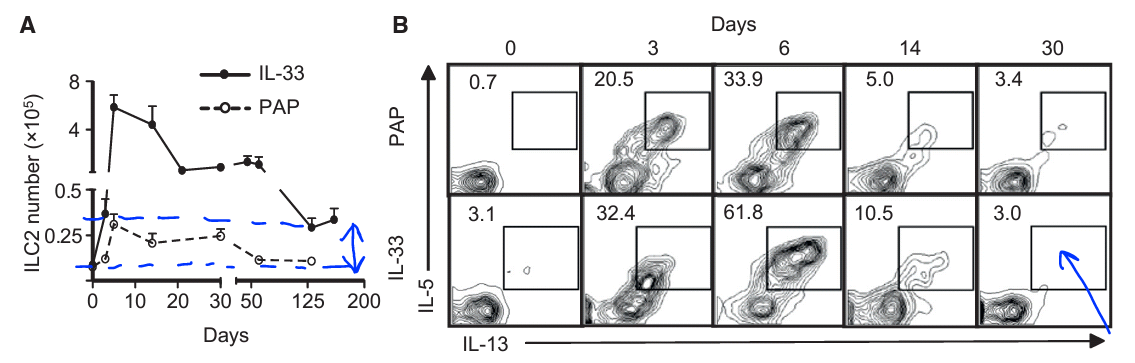

Importantly, when IL-33 primed mice were challenged with allergen one month later ILC2 showed heighten type II response to allergen (papain) but not to control (saline). This response was "allergen"[protease]-specific but antigen-independent. It is possible that primed ILC2 were responding to IL-33 [or IL-25] released during papain challenge.


Similar data were obtained from mice primed with fungal Aspergillus protease (ASP) allergen and challenged 3.5 months later with papain (but not to saline). Here too, primed ILC2 could be responding [indirectly] to IL-33 or IL-25 released by papain.


In summary, this study showed that at least in mice "primed" innate lymphoid cells retain "heightened" non-specific responsiveness to allergen "long-term" (up to 6 months). This could explain why adaptive TH2 cell targeting immunotherapies may not be fully successful because it ignores contributions from innate cells such as ILC2.

David Usharauli


Wednesday, April 6, 2016

Type II immunity is fueled by ILC2-specific arginase-1

In recent years much attention has been focused on group of innate cells called innate lymphoid cells (ILCs). There are group 1 (TH1 behavior), group 2 (TH2 behavior) and group 3 (TH17 behavior) ILCs, so far.

This week, new paper in Nature Immunology from David Artis lab (extremely prolific research lab) showed that ILC2-specific arginase-1 (Arg1) contributes to lung allergic inflammation.

Arg1 is an enzyme that metabolizes the amino acid L-arginine. Most L-arginine metabolism occurs primarily in the liver, though immune cells can express it too during immune response (i.e. Arg1 activity is a key signature of alternatively activated macrophages). Here, fate-mapping study of Arg1-YFP-expressing cells in lungs of naive mice showed that Arg1 was mostly expressed by ILC2.


Papain challenge (TH2 trigger) induced expansion of Arg1+ lung ILC2.


Using genetic mouse model where Arg1 is selectively absent in ILC2, Arg1ΔILC, the authors showed that Arg1 deficiency impaired ILC2 expansion and allergic lung inflammation upon papain challenge.


Finally, the authors showed that lung allergic inflammation was not impaired if Arg1 was missing from macrophage lineage (Arg1ΔLyz2), implying dominant role of ILC2-derived Arg1 in papain induced lung allergic inflammation.


In summary, this study revealed ILC2-specific role of Arg1 in promoting type II immunity in response to TH2 triggers (papain and helminth parasite N. brasiliensis).

David Usharauli


Saturday, March 26, 2016

Papain protease activity and mast cells, but not IL-33, are necessary for papain allergic sensitization

Papain is a proteolytic enzyme from papaya. Like other protease allergens such house dust mites (HDM) group 1 allergen, Der p 1, papain is allergen that belongs to family of cysteine proteases. Papain can induce skin contact sensitization or airway hyper-reactivity. 


When injected in mouse ear lobes, intact papain, but not protease-inactive papain (E64-papain), induced skin inflammation and IgE production.


Papain induced IgE production after skin challenge depended on presence of functional mast cells as (a) such response was diminished in mast cell–deficient WBB6F1-W/Wv (W/Wv) mice, and (b) such response could be recovered after transfer of WT mast cells. 


However, unlike mast cells, IL-33 was dispensable for IgE production after papain skin [primary] challenge (though IL-33 played the role in lung eosinophil infiltration later on, upon airway re-challenge with intact papain).


In summary, this study indicate that initial skin sensitization with papain required mast cells but not proto-TH2 innate "primer" cytokine IL-33. This knowledge should be incorporated in therapeutic strategies targeting IL-33 pathway (IL-33 and its receptor ST2).

David Usharauli