Showing posts with label ILC2. Show all posts

Wednesday, July 13, 2016

ILC2 sustain antigen-independent allergic responses

Most allergies represent exaggerated type II immune responses driven by adaptive Th2 cells. At least, this is what we used to believe it. However, discovery of rare innate cells, referred as innate lymphoid cells (ILCs), is slowly changing our understanding of cellular responses underlying allergies.

It is clear now that in laboratory mice model of allergy, type 2 ILCs (ILC2) contribute significantly and non-specifically [it seems] in sustaining allergy to irritant-allergens.


When analyzed ILC2 response to IL-33 or papain in lung tissue, the authors found that ILC2 displayed a typical adaptive-like behavior (expansion, contraction, quiescence).

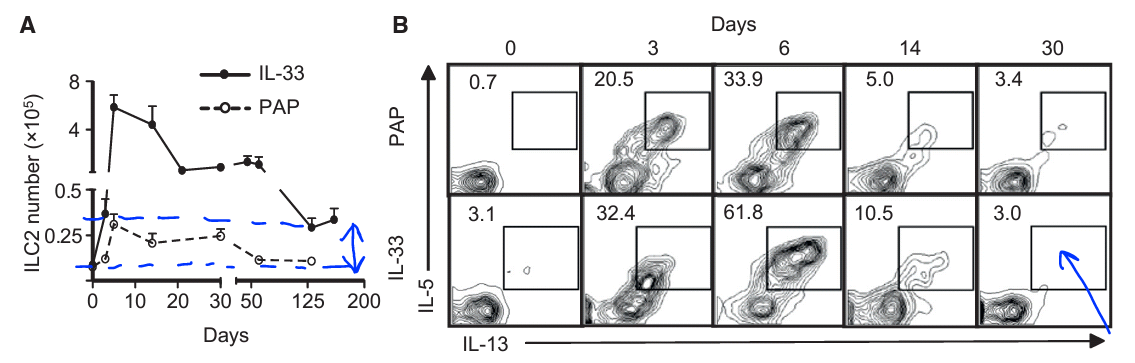

Importantly, when IL-33 primed mice were challenged with allergen one month later ILC2 showed heighten type II response to allergen (papain) but not to control (saline). This response was "allergen"[protease]-specific but antigen-independent. It is possible that primed ILC2 were responding to IL-33 [or IL-25] released during papain challenge.


Similar data were obtained from mice primed with fungal Aspergillus protease (ASP) allergen and challenged 3.5 months later with papain (but not to saline). Here too, primed ILC2 could be responding [indirectly] to IL-33 or IL-25 released by papain.


In summary, this study showed that at least in mice "primed" innate lymphoid cells retain "heightened" non-specific responsiveness to allergen "long-term" (up to 6 months). This could explain why adaptive TH2 cell targeting immunotherapies may not be fully successful because it ignores contributions from innate cells such as ILC2.

David Usharauli


Wednesday, April 6, 2016

Type II immunity is fueled by ILC2-specific arginase-1

In recent years much attention has been focused on group of innate cells called innate lymphoid cells (ILCs). There are group 1 (TH1 behavior), group 2 (TH2 behavior) and group 3 (TH17 behavior) ILCs, so far.

This week, new paper in Nature Immunology from David Artis lab (extremely prolific research lab) showed that ILC2-specific arginase-1 (Arg1) contributes to lung allergic inflammation.

Arg1 is an enzyme that metabolizes the amino acid L-arginine. Most L-arginine metabolism occurs primarily in the liver, though immune cells can express it too during immune response (i.e. Arg1 activity is a key signature of alternatively activated macrophages). Here, fate-mapping study of Arg1-YFP-expressing cells in lungs of naive mice showed that Arg1 was mostly expressed by ILC2.


Papain challenge (TH2 trigger) induced expansion of Arg1+ lung ILC2.


Using genetic mouse model where Arg1 is selectively absent in ILC2, Arg1ΔILC, the authors showed that Arg1 deficiency impaired ILC2 expansion and allergic lung inflammation upon papain challenge.


Finally, the authors showed that lung allergic inflammation was not impaired if Arg1 was missing from macrophage lineage (Arg1ΔLyz2), implying dominant role of ILC2-derived Arg1 in papain induced lung allergic inflammation.


In summary, this study revealed ILC2-specific role of Arg1 in promoting type II immunity in response to TH2 triggers (papain and helminth parasite N. brasiliensis).

David Usharauli


Thursday, November 5, 2015

IL-13/CCL17 axis drives Th2 memory response to allergen

Allergic response is immunological "mystery". In allergy, first step is sensitization when immune system detects new entity [hapten/antigen] and marks it for IgE mediated destruction. This step is more confusing because all kind of bio/chemical entities could be marked for IgE path by immune system, for no apparent reason.

No universal hypothesis exists that could explain and predict allergic response. Right now, we are just left to treat clinical "effector stage" [that usually happens during re-challenge with the same entity].

The following paper from Nature Immunology is one of those type of research articles. Here, the authors showed that memory Th2 response to allergen require engagement of IL-13 producing innate lymphoid cell type 2 (ILC2), followed by CCL17 producing DCs.

The authors used papain allergy model. In this model eosinophils are rapidly recruited in response to papain re-challenge (at day 15).

Next, the authors used gene-modified mouse strain (ICOS-T mouse) where ILC2 could be selectively depleted. Papain re-challenge of ICOS-T mice depleted of ILC2 reduced Th2 accumulation in the lung.
Next, the authors found that IL-13 and CCL17 were rapidly produced in the lung upon papain re-challenge.


They found that ILC2 were primary producers of IL-13 upon papain re-challenge.


They also found that neutralization of either IL-13 or CCL17 reduced Th2 accumulation in the lung upon papain re-challenge.
Next, the authors found that IL-13 receptor expression on DCs were necessary for lung CCL17 production and Th2 accumulation in response to papain re-challenge.


Finally, the authors showed that similar mechanism of Th2 accumulation was operational in papain re-challenged skin as well.


In summary, this study indicates that effector stage of allergic response were promoted by IL-13ILC2 / CCL17DCs axis. This knowledge provides additional therapeutic targets for allergy management.
 
David Usharauli

Wednesday, September 2, 2015

Adaptive Th2 cells can double as innate cells during allergy and helminth infection

Antigen specificity is a dominant feature of adaptive immune system. However, on occasions, fully differentiated effector T cells do show TCR-independent responsiveness to cytokines. Whether this is a good or bad thing is not easy to tell. 


For this study the authors had used a dual-reporter mouse model, called 4C13R, where both cytokine IL-4 and IL-13 are genetically labeled. Initially, the authors showed that adoptively transferred in vitro differentiated Th2 OT-II transgenic T cells, on 4C13R background, could secrete IL-13 (but not IL-4) in response to cytokine IL-33 (in combination with STAT5 activator IL-7 or TSLP).


Similarly, the authors observed TCR-independent IL-13 secretion by in vivo differentiated Th2 OT-II 4C13R cells to a Papain challenge (Papain is a protease and has been shown to induce type II immune response).


This TCR-independent secretion of IL-13 by differentiated Th2 cells was driven by IL-33.


Since type 2 innate lymphoid cells (ILC2) are known to respond to IL-33, the authors analyzed secretion of IL-13 by both Th2 and ILC cells after Papain challenge (here, mice were initially exposed to N. brasiliensis, a type II activator helminth). Both population could respond to Papain by secreting IL-13 (but not IL-4).


Similar results were obtained with another allergen, house dust mite extract (HDM).


Further experiments with RAG2-IL-2Rγ DKO hosts, which lack endogenous T and ILC2 cells, revealed that adoptive transfer of in vitro differentiated Th2 cells was sufficient to induce eosinophilia in lung tissue upon HDM exposure (allergen exposure).


The authors reasoned that in physiological situations initial antigenic priming would increase the number of Th2 cells to the level comparable to that of ILC2 and this would play a significant role in host protection or response to type II irritants (worm or allergen). Indeed, the authors showed that Th2 cells developed after first helminth infection could provide partial host protection to a second helminth infection, even in absence of ILC2 cells (in RORα bone marrow chimera).


In summary, these results suggest that adaptive immune cells can take the function of innate cells when necessary. Here, IL-13 appears to be a dominant cytokine that drives type II immune effector function (in 1990s ad early 2000s, the prevalent hypothesis positioned IL-4 in the center of type II immune effector response).

Such TCR-independent responsiveness has important implications for treatments of type II immune disorders such as allergy or dermatitis. For example, antigen (TCR ligand) desensitization protocol for allergy treatment may not provide full protection against allergic reaction due to IL-13 secretion (since it can be secreted independent of TCR signaling). On the other hand, blockade of IL-13 and IL-33 signaling may represent clinically relevant therapy (alone or in combination with antigen desensitization).  

David Usharauli
   

Wednesday, March 18, 2015

IL-33 links innate lymphoid cells group 2 to lean body mass control

There is one aspect of immune system that I did not get at all. It is related to the role of immune system in maintaining a lean body mass by controlling browning [beiging] of white adipose tissue and increasing energy expenditure.

Previous studies have implicated immune cells, such as eosinophils, type 2 macrophages and IL-4rα signalling in body energy expenditure and lean body mass control. New study in journal Nature has provided evidence suggesting that type 2 innate lymphoid cells, ILC2 and IL-33 play an independent and non-redundant role in lean body mass control and energy expenditure

The authors showed that in both human and mouse, white adipose tissue contain LinIL-25IL-127+population expressing IL-33R typical for ILC2. The frequency and number of ILC2 population in white adipose tissue were inversely correlated with obesity or high fat diet.


Experiments with IL-33KO mice or recombinant mouse IL-33 showed that ILC2 population in white adipose tissue retracted or expanded depending on presence of IL-33.


Adipose tissue analysis revealed that IL-33 induced UCP1 expression in white adipose tissue. UCP1 is responsible for high energy expenditure in beige fat.


Adoptive transfer of ILC2 into ILC2-deficient hosts showed that IL-33 worked through ILC2. Additional experiments revealed that IL-33/ILC2 axis worked independently from eosinophils, regulatory T cells or IL-4rα signalling.


Somewhat similar results were presented in another paper published in journal Cell earlier this year. However, in that paper the authors observed that eosinophils and IL-4rα signalling were also involved alongside with IL-33/ILC2. It would be interesting to know what is the reason for this discrepancy.

In summary, these results points to a novel function of innate immune system. Though It may even nothing to do with immune function per se but rather linking ancient metabolic pathways to innate immune cells. Even if IL-33 can help to reduce body fat, it does not necessarily means that we could start injecting obese people with IL-33. IL-33 has been implicated in pathological responses as well, like asthma or allergy. Only global view of cytokine function could tell us the real usefulness of any finding. Discrete, individual disease models are insufficient for this task and could lead to wrong conclusions. 

David Usharauli