Showing posts with label mast cells. Show all posts

Saturday, March 26, 2016

Papain protease activity and mast cells, but not IL-33, are necessary for papain allergic sensitization

Papain is a proteolytic enzyme from papaya. Like other protease allergens such house dust mites (HDM) group 1 allergen, Der p 1, papain is allergen that belongs to family of cysteine proteases. Papain can induce skin contact sensitization or airway hyper-reactivity. 


When injected in mouse ear lobes, intact papain, but not protease-inactive papain (E64-papain), induced skin inflammation and IgE production.


Papain induced IgE production after skin challenge depended on presence of functional mast cells as (a) such response was diminished in mast cell–deficient WBB6F1-W/Wv (W/Wv) mice, and (b) such response could be recovered after transfer of WT mast cells. 


However, unlike mast cells, IL-33 was dispensable for IgE production after papain skin [primary] challenge (though IL-33 played the role in lung eosinophil infiltration later on, upon airway re-challenge with intact papain).


In summary, this study indicate that initial skin sensitization with papain required mast cells but not proto-TH2 innate "primer" cytokine IL-33. This knowledge should be incorporated in therapeutic strategies targeting IL-33 pathway (IL-33 and its receptor ST2).

David Usharauli


Monday, October 19, 2015

Food allergies caused by mast cells with a serial number 9

Allergies are complex immune responses. Whether allergic reaction have any "protective" function or represent a purely pathological reaction is still debated. Classical form of allergy is IgE mediated and require IL-4 and Th2 cells. However, the list of effector molecules and cells responsible for various forms of allergic reactions are continuously expanding.

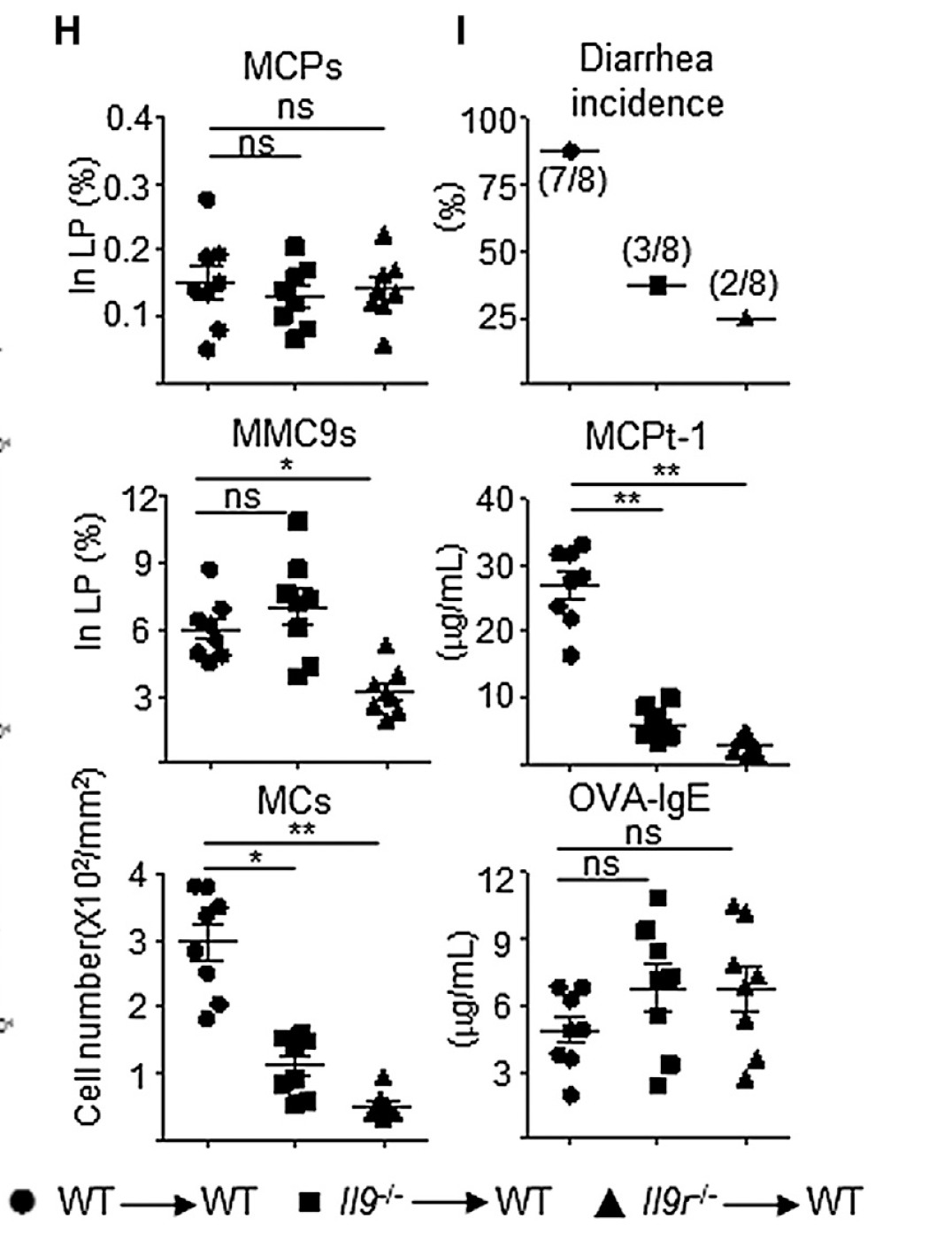
For example, in a recent paper in Immunity the authors showed that certain mouse models of food allergy were driven by mucosal mast cells secreting high level of IL-9.

This is quite messy paper with lots of figures. In fact, it was under review for one year [and it shows by its lack of harmonized relationship between figures]. 

Initially, using mouse model of food sensitization [intra-gastric antigen gavage], the authors showed that allergic reactions (e.g. diarrhea) to antigen in susceptible mouse strains correlated with the number of GI mast cells, not serum IgE. Moreover, such correlation was highly significant for IL-9 producing lamina propria Lin-/- population in susceptible mouse strains [since not every mouse strain develop allergic response in this setting].


Further investigation with IL-4eGFP reporter mice revealed that this IL-9 producing Lin-/- population belonged to mast cell lineage, rather than innate lymphoid cell type 2 (that express IL-25 cytokine receptor IL-17RB).


Next, the authors showed that induction of IL-9+ mast cells (MMC9) required IL-4, STAT6 and T cells.

Finally, using BM chimera experiments the authors showed that while active signaling through IL-9 was dispensable for MMC9 induction, it was required to produce allergic phenotype.


In summary, this study suggests that GI tissue associated mast cell secreting high levels of IL-9 play a role in allergic response to sensitized antigens. The development of this MMC9 requires signaling via IL-4, STAT6 and T cells, implying typical Th2-driven immune response. It is possible [but not formally tested in this study] that therapeutic targeting of IL-9 pathway may benefit patients suffering from GI tract allergies to food.

David Usharauli

Thursday, March 12, 2015

Nociceptor analog, MRGPRX2, mediates pseudo-allergic response to pharmacological compounds

Classical allergic response is mediated via IgE. However, some allergic responses to small peptides, pharmacological or chemical compounds are independent of IgE. 


The authors showed that mast cells from mice deficient for Mrgprb2 expression failed to respond to classical mast cell activator (secretagogue), compound 48/80, while retaining IgE mediated responsiveness.


Additional experiments confirmed that Mrgprb2 mediated injection site reactions (ISR) and mast cell histamine release in response to drugs such as Icatibant (bradykinin-receptor antagonist), tubocurarine (skeletal muscle relaxant) and ciprofloxacin (fluoroquinolone antibiotic).


Knowledge of chemical motifs (THIQ) responsible for Mrgprb2 activation will help to prevent and treat pseudo-allergic reactions to life-saving medical drugs.

David Usharauli