The mouse strain, NOD, has been used to study the mechanism of type 1 diabetes (T1D). These mice spontaneously develop autoimmune diabetes though it is not clear how islet-specific T cells get activated. To track autoimmune T cell fate, TCR transgenic mice, BDC2.5XNOD, have been used. These mice harbor islet-specific TCR expressing T cells in high numbers that are easily monitored.
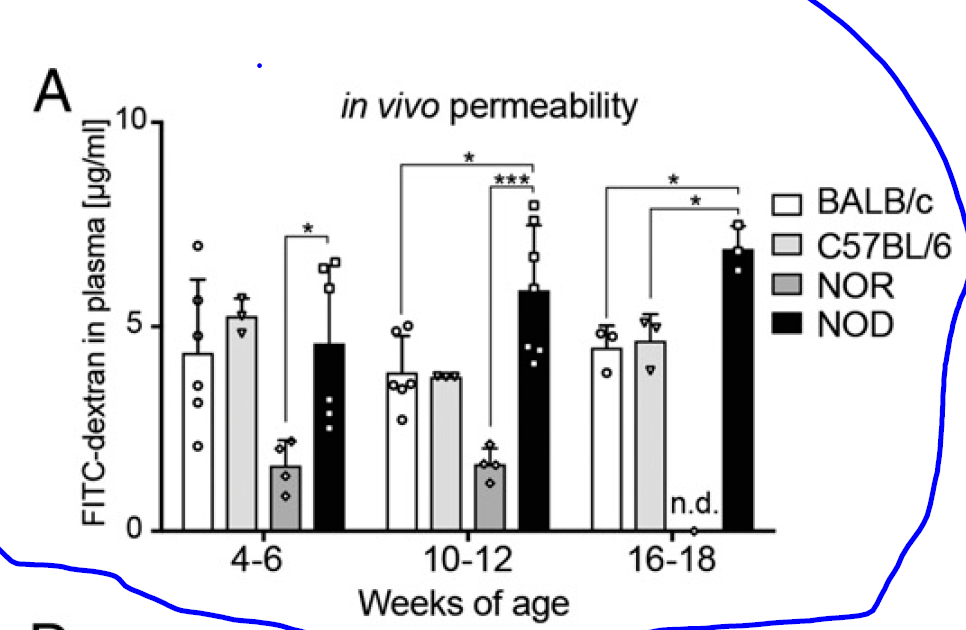
A new study in PNAS did some experiments on BDC2.5XNOD mice to understand the initiation of autoimmunity. First, they showed that the NOD background showed increased gut wall barrier permeability by measuring the FITC-dextran level in the blood after oral application (though they did not show the same permeability test for BDC2.5XNOD mice).

A new study in PNAS did some experiments on BDC2.5XNOD mice to understand the initiation of autoimmunity. First, they showed that the NOD background showed increased gut wall barrier permeability by measuring the FITC-dextran level in the blood after oral application (though they did not show the same permeability test for BDC2.5XNOD mice).
Interestingly, BDC2.5XNOD mice do not develop spontaneous autoimmune diabetes. However, oral application of low-dose dextran-sulfate sodium (DSS) activates T cells and initiates diabetes.


Diabetes, however, does not develop if DSS-treated BDC2.5XNOD mice are depleted of endogenous microbiota or if naive BDC2.5XNOD mice received DSS-modified microbiota.

In summary, this study showed that both gut inflammation and microbiota are necessary for the initiation of autoimmune diabetes in BDC2.5XNOD mice. The most likely scenario is that changes introduced by DSS allow endogenous microbiota to activate islet-specific T cells via cross-reactive antigens. DSS modifies both gut wall permeability and microbiota. Both of these phenomena have been observed by the authors. They conclude that "restoration of a healthy gut barrier through microbiota and diet modulation in diabetes-prone individuals could ultimately reduce intestinal activation of islet-reactive T cells and prevent T1D occurrence".
Others, in news/views for this article, even suggested using antibiotics to deplete endogenous microbiota, but in my opinion, this is a premature suggestion because the authors did not show that microbiota depletion after diabetes has already developed could stop it.
posted by David Usharauli


