Showing posts with label α-CTLA4. Show all posts

Thursday, June 2, 2016

Combination of checkpoint inhibitor and IL-21-primed melanoma-specific T cells produced durable response, "cure", in melanoma patient


Of note, earlier attempts to stop melanoma progression in this patient with IL-2/IL-7/IL-15 primed MART1-reactive "monoclonal" CD8+ T cells and/or Yervoy were not successful. As seen before, successful anti-melanoma immunotherapy produced autoimmune skin/hair disorder, vitiligo (loss of melanocytes)


As the cellular level, IL-21 priming resulted in better survival of infused polyclonal T cells and epitope spreading targeting other melanoma antigens such as NY-EOS1, gp100, tyrosinase and MAGE-A3.


In summary, this study clearly shows the vast [not yet fully tapped] potential of cancer immunotherapy.

David Usharauli


Thursday, January 7, 2016

DC vaccine synergizes with αCTLA4/αOX40 against solid tumors

The Objective of any tumor immunotherapy is to achieve tumor-specific T cell response while avoiding any bystander T cell activation. The reason why checkpoint inhibitors, such as αPD-1 and αCTLA4 antibodies work only in a fraction of patients have to do with the fact that only those "responders" have enough pre-existing tumor-specific T cells "responsive" to αPD-1 and αCTLA4 inhibitions. 

Other patients are refractory because their immune system is "blind" or "ignorant" of tumor antigens, i.e. first stage of T cell priming has failed due to lack of antigenic load in DCs (for example, if tumor express few mutated antigens). This situation, however, is potentially reversible with DC vaccines, wherein tumor-specific antigens/epitopes are loaded into DCs. Such "loaded" DCs would then prime T cells which in turn become responsive to checkpoint inhibitors.

So, solid tumor immunotherapy would require multi pronged approach to improve its efficacy. In this regard, I found this new paper in PNAS worth reviewing. Here, the authors showed that combination of "loaded" DC vaccine with αCTLA4/αOX40 treatment were able to overcome dormant state of T cells and allowed efficient control of solid tumors.

Initially, the authors showed that dual αCTLA4/αOX40 antibody treatment allowed substantial expansion of antigen-specific CD8 T cells (in a CD4 T cell-dependent manner).


However, these expanded CD8 T cells were not able to control solid tumor in mice challenged with HER2-expressing TUBO mammary cancinoma cells. However, when αCTLA4/αOX40 antibody treatment were combined with DC vaccine (DEC-205/HER2/PolyI:C), half of tumor challenged mice achieved long-term tumor-free status. 


Now, this is just an example of what potentially could be accomplished with the right concept. In general, OX40 is a complex molecule that has additional role in TH2 immunity, so it is not clear whether this particular combination would be useful in humans. PolyI:C, TLR3 agonist, is not approved for human use either, so it is also not very relevant right now.

In summary, combination of DCs vaccine with checkpoint inhibitors could add missing piece necessary to arm T cells against solid tumors.

David Usharauli

Saturday, November 28, 2015

Immunotoxins show anti-cancer synergy with immune checkpoint inhibitors

This week Science Translational Medicine published 2 papers directly or indirectly related to Foxp3T cells [this is in in addition of two Foxp3+ T cell papers in Nature]. Since I am very curious about the role of Foxp3+ T cells in immune regulation I decided to review them.

First paper I review here is not a typical Foxp3+ T cell paper. It is actually a study of tumor immunotherapy. The authors showed that when combined with checkpoint inhibitors CTLA-4/PD-1, direct tumor immunotoxins, such as T-DM1 [trastuzumab emtansine], significantly augment anti-cancer immune response and immune memory.

Trastuzumab [herceptin] is a humanized antibody that targets HER2 antigen over-expressed in breast cancer cells. Initially, the authors showed that anti-cancer effect of ado-trastuzumab conjugated to cancer toxin, T-DM1 (Kadcyla®), was depended on T cells [as revealed by T cell depletion]. This suggested potential synergy with checkpoint inhibitors.


Indeed, a combined application of T-DM1 and CTLA-4/PD-1 antibodies showed close to  100% protection against breast cancer in mice.


Surprisingly, the authors noticed that combo therapy, that fully protected mice against tumors, actually increased infiltration of tumor tissue by functioning Foxp3+ T cells [in addition to conventional T cells]. This was counter-intuitive.


However, T cell depletion confirmed that when CD4 T cells [that includes Foxp3+ T cells] were removed, more than 50% of mice on combo therapy [100% tumor-free] developed severe autoimmune inflammation [results with Treg-specific depletion would have been more valuable here, of course].


In summary, this study points to 2 distinct results: first, direct cancer cytotoxocity by immunotoxins could synergize with checkpoint inhibitors, probably via efficient antigen uptake and DC maturation [antigen processing stage]. Second, tumor infiltrating Foxp3+ T cell could play not yet understood tissue protective role during such combo immunotherapy [in effector stage].

David Usharauli


Sunday, March 15, 2015

Synergy of checkpoint inhibitors for tumor immunotherapy

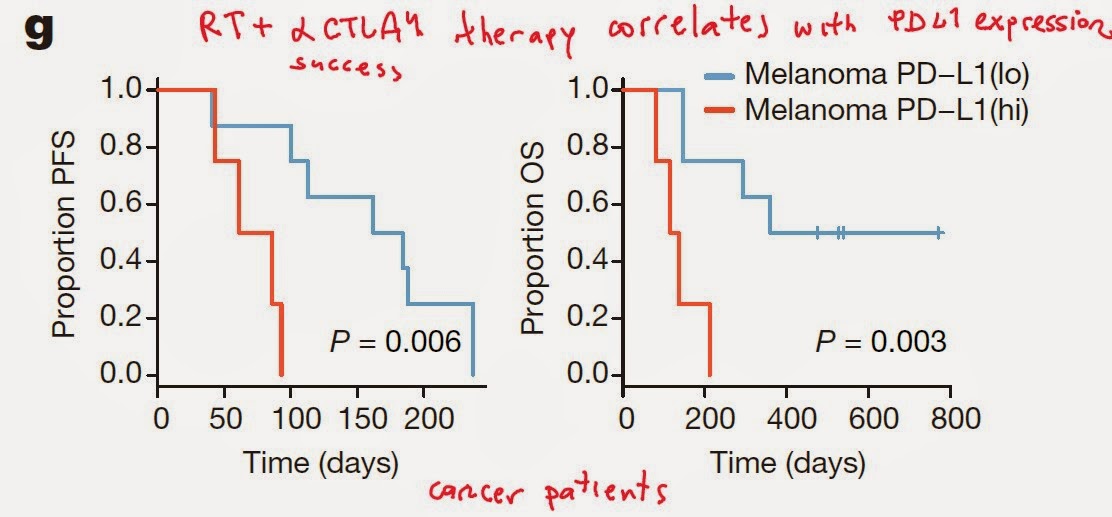
Introduction of checkpoint inhibitors, α-CTLA4 and α-PD1/PD-L1 humanized antibodies, injected new hope in cancer immunotherapy. Still, these clinical advances are at early stage and the significant benefits are achieved in small proportion of patients (~ 20%, for solid tumor patients). 


The concept is similar to treatment of antibiotic resistant pathogenic microorganisms. Single mechanism of action usually is not sufficient for successful treatment since microorganisms are quick to adapt and develop resistance to it.

Tumors, too, frequently behave as the separate macro-organisms within the body. When coming under immune pressure exerted by α-CTLA4 antibody, tumors will try to escape immune surveillance by up-regulating parallel inhibitory pathways such as PD1/PD-L1 system. 


Identification and simultaneous targeting of such inhibitory and/or escape strategies will finally provide clearly measurable clinical benefits in majority of tumor patients.

David Usharauli