Showing posts with label synergy. Show all posts

Sunday, July 24, 2016

Fasting or fasting-mimicking diet synergize with anti-tumor chemotherapy

Two new papers in Cancer Cell caught my attention this week. In these studies scientists showed that fasting or fasting-mimicking diet (low calorie diet or calorie restriction mimetics) synergize with anti-cancer chemotherapy in a T cell-dependent manner.

For example, in one study it was found that in mice 48h fasting (0 calorie, very harsh "diet") or application of calorie restriction mimetics such as hydroxycitrate (that reduces cellular protein acetylation, thereby increasing autophagic flux) synergized with such anti-cancer chemotherapies as mitoxantrone (MTX) in a CD8 T cell-dependent manner.


Interestingly, this calorie restriction mimetic (HC) could not further enhance anti-cancer effect of chemotherapy in regulatory T cell-depleted [anti-FR4 treated] mice (i.e. it worked by restraining Tregs function).


Another paper also showed that fasting-mimicking diet could also reduce toxic effect of chemotherapy on healthy tissue in WT or T cell-deficient mice (independent of its anti-cancer synergy).


In summary, these two papers support idea that controlled calorie restriction could provide benefits to cancer patients during chemotherapy.

David Usharauli


Thursday, April 14, 2016

T cell compatible cancer chemotherapy synergizes with cancer adjuvant vaccine

Nowadays it is well acknowledged that optimal cancer treatment would require multi-pronged approach, for example, combining cancer chemotherapy with cancer antigen-specific vaccine to boost tumor-specific T cell response. However, such combination is not always feasible since (a) both tumor and activated T cells are highly proliferative cell types and (b) vast majority of chemotherapy drugs target cellular replication machinery. Basically, it is matter of trial and error to find T cell compatible chemotherapy drugs.


Most cervical cancers in humans are induced by human papillomavirus type 16 (HPV16). Initially, the authors showed that CarboTaxol synergized with HPV16-SLP vaccination in HPV16-positive TC-1 tumor-bearing mouse model.


Next, the authors noticed that CarboTaxol [and vaccine too] reduced level of CD11bhighGr1high myeloid [suppressor] population within tumor tissue.


Similar depletion of myeloid population was observed in blood samples of cervical cancer patients undergoing CarboTaxol therapy.


In fact, CarboTaxol treatment cycles significantly improved T cells proliferation in response to minor [bacterial recall antigen mixture, MRM)] and major HLA antigens [MLR].


Finally, combining CarboTaxol treatment with HPV16-SLP vaccination improved T cell stimulation in response to HPV16 antigens E6/E7.


In summary, this study indicates that CarboTaxol chemotherapy augments, rather than inhibits, tumor-specific T cell priming in response to HPV16-SLP vaccination.

David Usharauli


Sunday, March 15, 2015

Synergy of checkpoint inhibitors for tumor immunotherapy

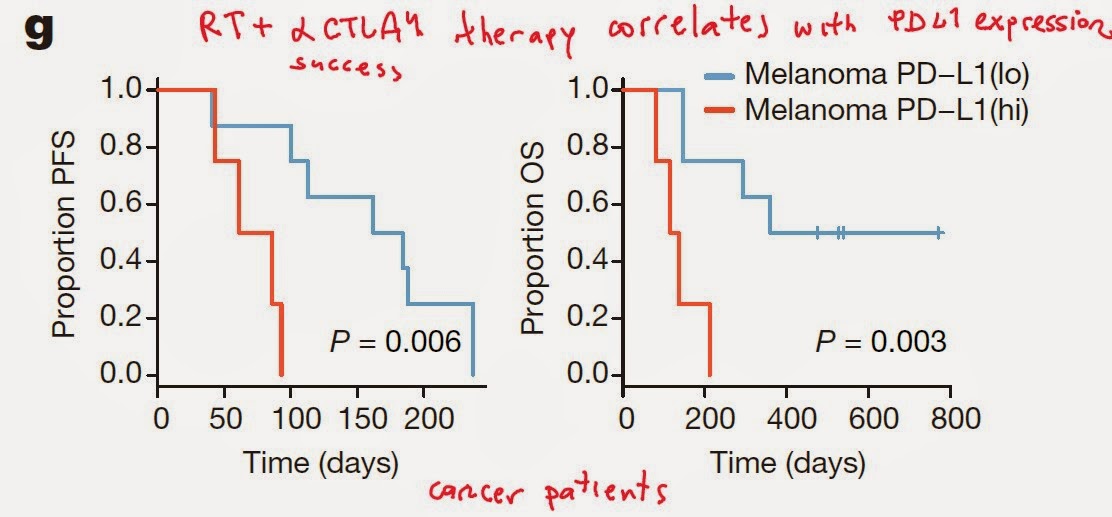
Introduction of checkpoint inhibitors, α-CTLA4 and α-PD1/PD-L1 humanized antibodies, injected new hope in cancer immunotherapy. Still, these clinical advances are at early stage and the significant benefits are achieved in small proportion of patients (~ 20%, for solid tumor patients). 


The concept is similar to treatment of antibiotic resistant pathogenic microorganisms. Single mechanism of action usually is not sufficient for successful treatment since microorganisms are quick to adapt and develop resistance to it.

Tumors, too, frequently behave as the separate macro-organisms within the body. When coming under immune pressure exerted by α-CTLA4 antibody, tumors will try to escape immune surveillance by up-regulating parallel inhibitory pathways such as PD1/PD-L1 system. 


Identification and simultaneous targeting of such inhibitory and/or escape strategies will finally provide clearly measurable clinical benefits in majority of tumor patients.

David Usharauli