Showing posts with label IgD. Show all posts

Thursday, October 1, 2015

B cell activation by antigen promotes desegregation of IgM and IgD islands

There are two models of B cell activation. In one model, B cell activation is promoted by clustering of individual IgM molecules. Second model, however, argues that B cell activation is promoted by de-clustering of IgM "islands". This second model is mainly based on research by Micheal Reth's lab.


To study B cell receptor architecture on resting or activated B cells, the authors have used 3 different but complementary approaches: (1) two-color direct stochastic optical reconstruction microscopy (dSTORM), (2) two marker transmission electron microscopy (TEM) and (2) proximity ligation assay (PLA). 

First, the authors showed that on resting B cells, both IgM and IgD are segregated into islands containing on average 30 IgM and 48 IgD molecules, respectively.


Next, the authors showed that upon activation, both IgM and IgD islands show reduction of number of receptors per islands, implying that individual IgM or IgD receptors are leaving the islands.  


Interestingly, the authors showed that both IgM and IgD islands could independently respond to the antigen.  


In addition, detection of IgM and IgD (co)-localisation by TEM after antigen exposure confirmed receptors meetup (receptors were detected by secondary antibodies conjugated to two different size gold particles).  


In summary, this study supports the hypothesis that upon B cell activation IgM and IgD receptors leave "home islands" and move close to each other, thus facilitating sharing of downstream signaling molecules. This study is a "biochemical" study that does not incorporate "biological" significance of BCR dissociation, however.   

David Usharauli

Saturday, April 11, 2015

Anergic B cells respond to polyvalent antigens via IgD receptor

Naive B cells express IgM and IgD receptors. Both receptors share the same unique immunoglobulin variable region but differ in immunoglobulin constant regions. IgM is secreted in response to antigenic signaling but not much is known regarding the role of IgD in immune response.

New study in Nature Immunology provided very interesting data about the function of IgD. It turned out that unlike IgM, IgD receptors only respond to polyvalent antigens.

The authors, led by Hassan Jumaa at the Institute of Immunology (Ulm, Germany), first showed that unlike IgM receptor, cell line expressing IgD receptors specific for hapten (NIP) or antigen (HEL) responded only to polyvalent antigenic forms.


Next, the authors find that these difference in response between IgM and IgD was related to the difference in hinge region (that connects variable and constant regions). IgD with no hinge region (IgDΔhinge) responded as if IgM and IgM with IgD hinge region responded as if IgD.


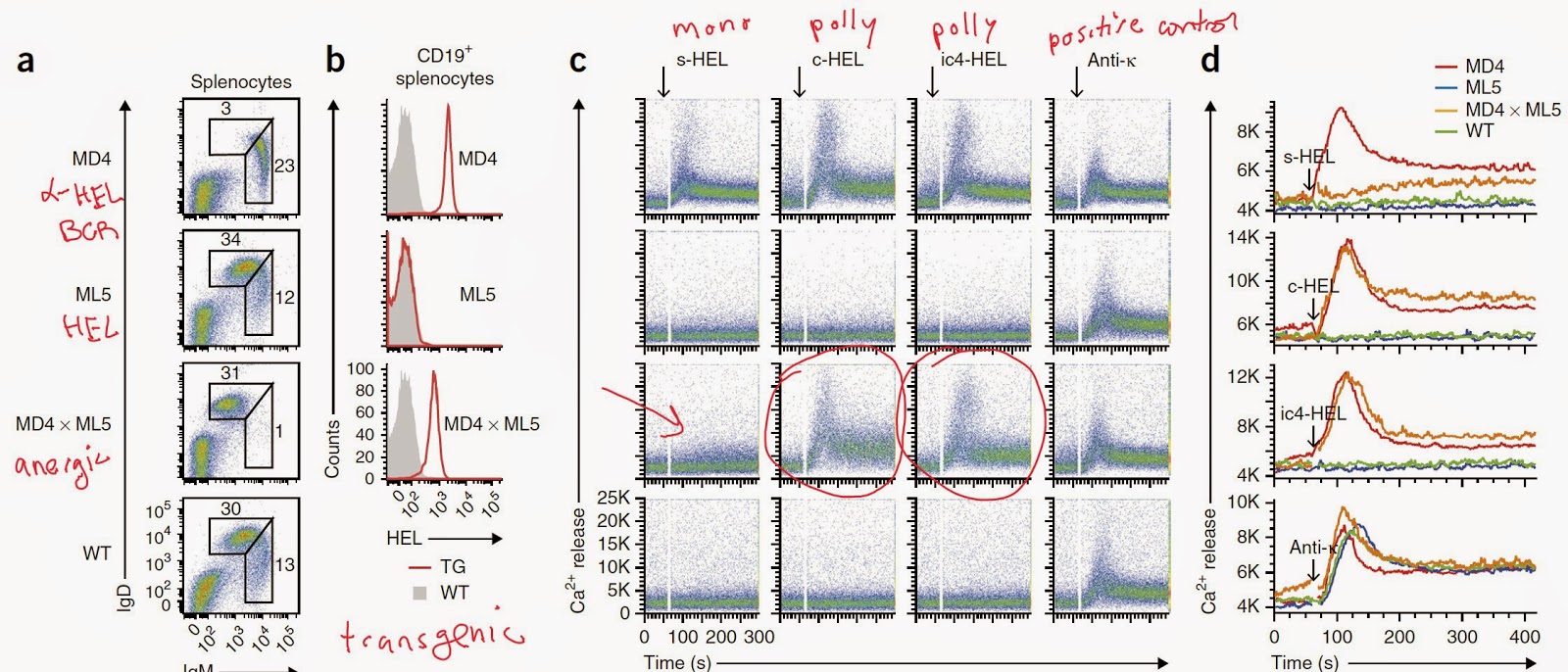
The authors observed that anergic B cells obtained from antigen (HEL)-specific B cell double transgenic mouse expressing soluble HEL (s-HEL) could still respond to polyvalent HEL antigen.


The authors showed that monovalent antigen could competitively inhibit IgD signaling in response to polyvalent antigens.


Next, the authors observed that functionally, absence of IgM receptor could compromise innate B-1 cells scavenging response (natural antibody response) to a soluble auto-antigen phosphatidylcholine (PtC).


Indeed, IgD receptor itself were unable to respond to a soluble phosphatidylcholine (PtC).


Finally, the authors also showed that the absence of IgM signaling compromised IgG scavenging functions against multiple auto-antigens (oxidized LDL, etc) as well.


In summary, this study revealed that anergic B cells (IgMlowIgDhigh) can respond to antigen when stimulated with polyvalent antigens. Probably the role of IgD receptor is to prevent improper activation of naive B cells in response to soluble antigens. I wonder what is the (a) phenotype of IgD KO mice or (b) whether auto-antigens targeted by natural antibodies are mono or polyvalent in nature?

David Usharauli