Showing posts with label IL-25. Show all posts

Tuesday, October 18, 2016

Bifurcation of type 2 immunity

Type II immunity is referred to a Th2 dominant immune response to a wide array of proteases, venoms and mechanical irritants. Both innate ILC2 cells as well as adaptive Th2 cells are involved in this process. The relationship between innate and adaptive components of type II immunity is still being defined.


For example, the authors showed that parasitic nematode Nippostrongylus brasiliensis (Nb)-infected mice triple deficient in sensing of TSLP, IL-25 and IL-33, the epithelial cytokines which have been linked to Th2 cell function, have normal lymph node IL-4+ Th2 differentiation and IgE production, but significantly diminished potential to secrete IL-13 and IL-5, effector Th2 cytokines, in the periphery. 


Importantly, such bifurcation of Th2 effector functionality was T cell intrinsic by sensing locally produced "release" cytokines, TSLP, IL-25 and IL-33.


In summary, this study indicate that even at the level of Th2 cells their effector functionality could be bifurcated depending on the local tissue micro-environment. This concept is important to better understand how to treat different types of allergies, for example, IL-4/IgE dominant systemic allergies versus IL-5/IL-13 dominant local tissue chronic allergies.     

David Usharauli

Wednesday, July 13, 2016

ILC2 sustain antigen-independent allergic responses

Most allergies represent exaggerated type II immune responses driven by adaptive Th2 cells. At least, this is what we used to believe it. However, discovery of rare innate cells, referred as innate lymphoid cells (ILCs), is slowly changing our understanding of cellular responses underlying allergies.

It is clear now that in laboratory mice model of allergy, type 2 ILCs (ILC2) contribute significantly and non-specifically [it seems] in sustaining allergy to irritant-allergens.


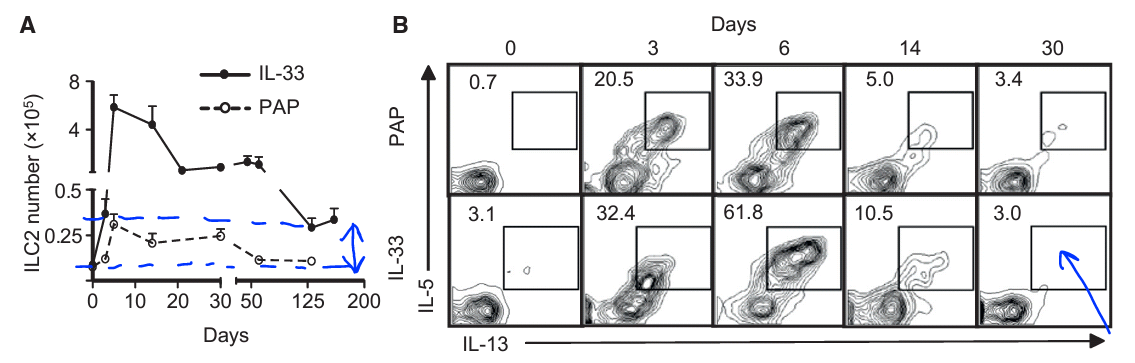
When analyzed ILC2 response to IL-33 or papain in lung tissue, the authors found that ILC2 displayed a typical adaptive-like behavior (expansion, contraction, quiescence).


Importantly, when IL-33 primed mice were challenged with allergen one month later ILC2 showed heighten type II response to allergen (papain) but not to control (saline). This response was "allergen"[protease]-specific but antigen-independent. It is possible that primed ILC2 were responding to IL-33 [or IL-25] released during papain challenge.


Similar data were obtained from mice primed with fungal Aspergillus protease (ASP) allergen and challenged 3.5 months later with papain (but not to saline). Here too, primed ILC2 could be responding [indirectly] to IL-33 or IL-25 released by papain.


In summary, this study showed that at least in mice "primed" innate lymphoid cells retain "heightened" non-specific responsiveness to allergen "long-term" (up to 6 months). This could explain why adaptive TH2 cell targeting immunotherapies may not be fully successful because it ignores contributions from innate cells such as ILC2.

David Usharauli