Showing posts with label oncolytic viruses. Show all posts

Tuesday, July 19, 2016

Oncolytic virus expressing PGE2 inactivating enzyme display enhanced anti-cancer effect

Oncolytic virus therapy is a new method of cancer therapy. Its goal is to selectively target cancer cells sparing healthy cells. However, not many tumors respond to it and so far it has limited application.


Initially, the authors tested in vivo susceptibility of several cancer cell lines to oncolytic vaccinia strain (WR.TK-Luc+). Some  cancers were less susceptible (Renca, 4T1), some more (LLC, MC38).


Susceptibility to WR.TK-Luctherapy was T cell mediated as CD8 T cell depletion could abolish it.


To overcome inhibitory micro-environment within resistant tumors oncolytic virus (OV) expressing prostaglandin-inactivating enzyme was designed. Indeed, modified OV therapy improved cancer protection.


Moreover, when combined with anti-PD1 therapy, modified OV could protect mice from resistant tumor such as Renca tumor, even when applied on established tumor (aspirin had no effect at this stage).


In summary, this study confirms that sustained inactivation of local prostaglandine source could drastically improve anti-cancer effect of OV, especially when combined with checkpoint inhibitors.

David Usharauli


Saturday, January 9, 2016

Tumor suppressor PTEN promotes anti-viral immunity

In recent years new and powerful immunothereutic strategies such as checkpoint inhibitors (anti-CTLA4/anti-PD1) and CAR-T cells entered into clinics. Moreover, just few months ago, another immunotherapeutic strategy, called oncolytic viral therapy, received FDA approval. This latter approach is very interesting. Basic claim is that this "so called" oncolytic viruses selectively infect and target tumor cells. Of course, this is a nonsense. No virus, including modified oncolytic viruses, could selectively infect tumor cells (and sparing healthy cells). However, analysis of the following paper would explain how oncolytic viruses would "prefer" cancer cells.


To understand significance of this finding in oncolytic immunotherapy, we need to remember that PTEN is a classic tumor suppressor (like p53), which is frequently mutated in cancer cells. Here, the authors initially found that PTEN -/- cells were deficient in type I IFN (but not IL-6) production upon viral infection.

PTEN -/- cells could be rescued to produce type I IFN by transfection with WT PTEN, but not phosphatase[activity]-deficient PTEN (though this PTEN anti-viral phosphatase activity was independent of its phosphatase activity for PI(3)K-Akt pathway).

In vivo experiments with tamoxifen-inducible Cre recombinase PTENLoxP/LoxP mice confirmed essential role of PTEN in anti-viral immunity.

These results could explain why tumors maybe selectively "susceptible" for oncolytic virus immunotherapy. If tumor cell lacks PTEN it becomes sensitive to viral infection since it will fail to produce basic defense anti-viral molecules such as type I IFNs. In a sense, a tumorigenic transformation of healthy cells (as a result of PTEN mutation) comes at cost of reduced anti-viral defense that could be exploited by therapy. However, oncolytic viruses are not regular WT viruses either. They are modified for reduced virulence (WT viruses would not get FDA approval, for sure). So, in the end, positive outcome with oncolytic virus therapy is a sum of (1) reduced anti-viral defense of cancer cells, (2) reduced virulence of oncolytic virus, (3) direct viral cytotoxicity of infected cancer cells, and (4) priming of oncolytic virus-specific T cells (and then cancer epitope spreading).

David Usharauli

Tuesday, May 19, 2015

Tumors repel immune system but attract lytic viruses

Clinically relevant tumors have two characteristics: uncontrolled proliferation (expansion) and immune evasion.

Surprisingly, several recent papers indicated that tumor transformations are associated with inhibition of cell-autonomous anti-viral/anti-modified RNA/anti-modified DNA recognition pathways such as RIG-I or STING.


First, the authors showed that cancer-associated fibroblast (CAF) showed [TGF-β dependent] increase in sensitivity to virus replication compared normal fibroblast harvested from the same cancer patient.


Next, the authors showed that cancer cells too become susceptible to viral infection when co-cultured with cancer associated fibroblast.


This viral titre enhancement was mediated by soluble factor.


Screen for active factors indicated that enhancing factor was fibroblast growth factor-2 (FGF-2). Indeed, inhibition of FGF-2 by RNAi reduced viral titre in tumor-CAF co-culture.


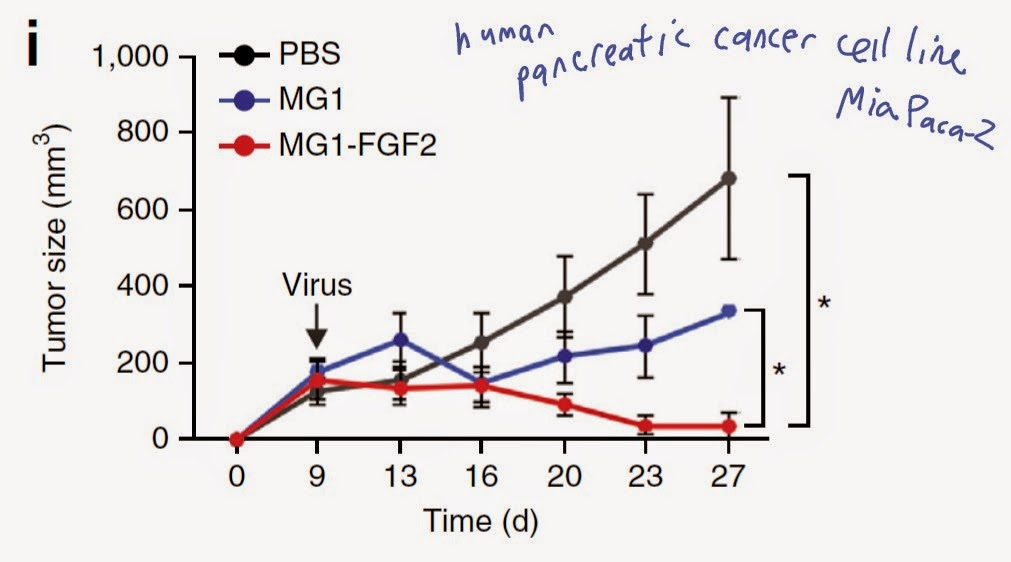
Finally, the authors showed that virus expressing FGF-2 could induce regression of established tumor in mouse model.


In summary, these results suggest that exploiting cancer vulnerability towards lytic viruses may be an alternative path for biological cancer therapy

Note: It is puzzling that virus targets only cancer cells. The authors explained such selective sensitivity of cancer cells based on reduced baseline anti-viral activity in cancer cells. However, we need to consider the fact that cancer patients maybe immune deficient in general, making them generally susceptible to viral infections.

David Usharauli