Showing posts with label murine norovirus (MNV). Show all posts

Tuesday, January 27, 2015

Orphan interferon-lambda vetoes commensal microbes backdoor dealings

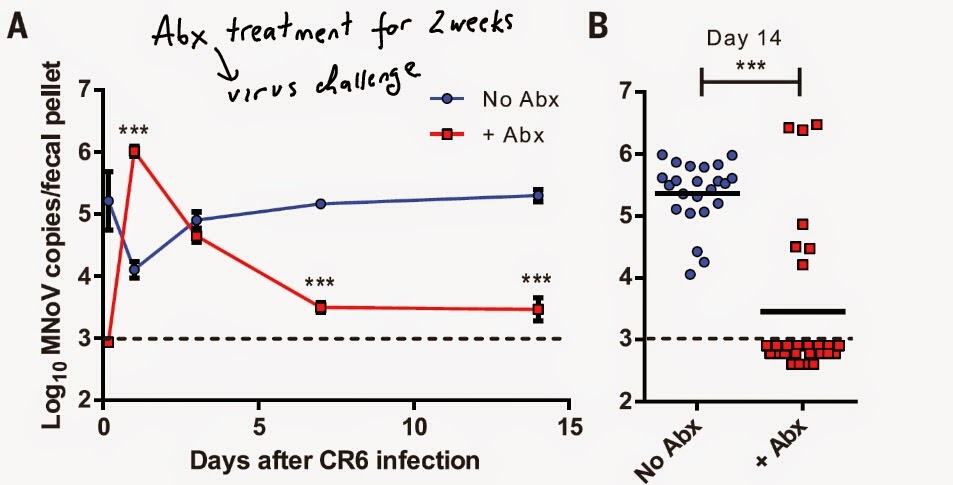
This is a second paper in IFN-lambda series. This new paper published in journal Science provided additional confirmation to the earlier study suggesting the role of commensal microbes in norovirus infection


This resistance to intestine norovirus infection was reversed by normal fecal supplementation implying the role of gut microbes in supporting norovirus infection.


The authors showed that resistance to chronic norovirus infection upon antibiotic treatment were dependent on viral dose and IFN-lambda signaling.


These data suggest that murine norovirus employs endogenous gut microbial flora to establish chronic intestinal infection. It is not clear how microbiota alters IFN-lambda signaling to permit norovirus persistence in the gut.

David Usharauli 

Monday, January 26, 2015

Interferon-lambda can do it but suffers from amnesia

Ordinarily when we consider anti-pathogen response we think about adaptive immune response with antibodies or T cells. However, the more we study innate immune system the more we uncover about its hidden potential

This new study in journal Science from Herbert Virgin's lab at the Washington University School of Medicine, showed new function for interferon molecule called IFN-λ. IFN-λ is a member of family called type III IFNs. 


First, the authors observed that mice deficient for IFN-lambda receptor 1 expression (IFN-λR1) (but not IFNγR or IFNαR1) showed high viral burden in the gut. 


Indeed, exogenous application of IFN-lambda could clear chronic murine norovirus infection from the gut in control wild-type and IFNalphaR1-KO mice but not from IFN-lambdaR1-KO mice.


Surprisingly, IFN-lambda was active against chronic murine norovirus infection even in RAG-KO mice lacking adaptive immune system.


Interestingly, IFN-lambda treated mice that clear first norovirus infection remained susceptible to second norovirus infection, implying the absence of immune memory.


In summary, the authors showed that for certain viral infection innate system can provide "sterile" immunity, though it lacked memory component.

Chronic viral infection exist because they are able to find ways to co-exist with both innate and adaptive immune system. Here, for example, the authors showed that norovirus (CR6 strain) was able to establish chronic gut infection in wild-type, IFN-lambda sufficient environment, because it did not activate IFN-lambda system. This knowledge may help to design optimal natural anti-viral treatments for human noroviral infections.   

David Usharauli


Monday, December 15, 2014

Commensal virus to the rescue

We all heard about gut microbiome and how an important job they do to keep us healthy. Still, there is the situations when the antibiotic therapy is necessary. 

Since many beneficial microbes in our gut are sensitive to broad spectrum antibiotics used in today's medicine, such treatment could lead to dysbacteriosis and gut inflammation. Now, beneficial microbiome therapy (fecal transplantation) is an obvious option, but such therapy could be inefficient due to the fact that such flora itself is sensitive to antibiotics. So what is the solution?

It appears that some friendly viruses in the gut could provide such beneficial, cover effect. Such study, led by Ken Cadwell from New York University School of Medicine, was recently published in journal Nature.

The authors studied the murine norovirus (MNV). This virus is endemic in laboratory mice colonies but does not produce an overt gut inflammation in a immune-competent host. 

Reconstitution of germ-free mice with MNV produced changes in the gut morphology and immune cells resembling conventional mice gut

More relevant, MNV could reverse antibiotic-induced negative effects on gut immune system.

Mechanistically, such beneficial effect of MNV on gut immune system was type I IFN dependent.
Finally, MNV could prevent antibiotic-induced gut sensitivity to chemical damage (DSS).

In summary, the authors showed that viral therapy could be an viable alternative (since virus would not be sensitive to antibiotic itself) to treat or prevent antibiotic-induced gut immune malfunctions.

Of course, application of this study to human population would require additional research. 

First, human Norovirus is clearly not a benign virus (cruise ship virus). So we need to find the virus that does not induce an overt gut inflammation in healthy humans. 

Second, this study examined immune-competent mice. However, analyses of immune-deficient mice responses to NMV would be more informative since in humans, antibiotic therapies are frequently used to compensate for immune deficiencies.

Third, if gut commensal, beneficial viruses exist, they should naturally (automatically) take over the beneficial microbes functions during antibiotic treatment. Do they do it?

Fourth, recent studies indicated that viruses, including MNV, require the presence of bacteria for their infectivity. How this knowledge affects the results of this study is to be determined.

David Usharauli