Showing posts with label immune complexes (ICs). Show all posts

Sunday, November 26, 2017

Allergen-sensitized mothers transfer protection against allergy to offspring through milk


In this study the authors showed that mouse pups born to mothers sensitized to allergen were significantly protected from developing allergic response to the same antigen.    


Protection in offspring was associated with the generation of antigen-specific Foxp3+ Tregs as observed in proliferation suppression assay or following short-term Treg depletion by DT (however, the authors did not analyze antigen-specificity of Tregs by tetramer staining). 


Further experiments showed that mother's milk contained allergen-specific antibodies and immune complexes (IC) and breastfeeding by allergen-sensitized mother (irrespective of birth mother status) was sufficient to transfer allergen protection to offspring.


In summary, this study suggests that breastfeeding by allergen-sensitized mothers can benefit offspring by preventing development of allergic response to the same allergen. However, it is not clear how exactly the authors see this mechanism working in humans. In mice, mothers were intentionally sensitized with allergen using epicutaneous (skin) application that supposed to mimic how humans with skin barrier dysfunction get sensitized to allergens. But the authors have not tested if milk from atopic human mothers can have the same effect on their offspring. For some reason the authors tested milk from nonatopic human mothers and showed that it 'worked' when fed to mice but did not provide any explanation why healthy, nonatopic human mother milk should contain any "protection" against allergen when mothers themselves are not sensitized as experiments in mice showed they must be for a milk derived immune complexes to work. So lots of unknowns and contradictions.

posted by David Usharauli


Sunday, July 12, 2015

Glycosylation directs IgG affinity selection during immune response

Immunoglobulin (Ig) Fc region determines Antibody effector functionality. In humans, for example, there are four types of IgG molecules that differ in their Fc domain structure: IgG1, IgG2, IgG3, IgG4. In addition, glycolysation (sugarization) of Fc fragments by syalic acid and fucose influences their binding to inhibitory or activatory Fc receptors.

In this new paper published in journal Cell, Jeffrey Ravetch's lab suggested a mechanism how glycolysation would optimize IgG affinity. This is a hybrid study involving both human and mouse studies. 

The authors have used influenza antigen HA as a model antigen. First, the authors showed that following flu vaccinination in healthy volunteers, overall abundance of sialylated IgGFc molecules (sFc) correlates with vaccine efficacy as measured by HAI.    


Next, to understand mechanism for improved HAI titers, the authors treated human B cells with immune complexes (ICs) derived either from sialylated (sIC) or asialylated (aIC) antigen-IgG conjugates. This experiments reveal that sialylated ICs induced up-regulation of inhibitory FcRIIb on antigen-specific B cells in a CD23-dependent manner. This could instruct antigen-specific B cells to undergo more stringent affinity-selection in germinal centers.


Antigen-antibody binding studies confirmed that in vivo immunization with sICs could elicit IgG1 with higher affinity in a CD23-dependent manner (this is a mouse study).


Finally the authors showed that unlike pure HA antigen immunization, immune sera derived from mice immunized with sICs displayed superior activity against flu virus expressing stalk region (this region is a target for universal anti-flu antibodies).


In summary, these results suggest that efficacy of vaccination protocols is influenced by overall abundance of sialylated IgG1 molecules. However, it is not clear whether this optimization of IgGresponse are physiologically happening following primary (naive) or secondary (memory) immune response. Another point is whether this particular strategy with sICs is feasible for human vaccination protocols. 

David Usharauli


Saturday, March 7, 2015

Persistence of immune complexes (ICs) impair Fc-receptor effector functions

Chronic viral infections represent incompletely understood immune condition. Previously it has been shown CD8 T cells functions were impaired during chronic viral infections. 

Now, two new back-to-back papers in journal Immunity provided evidence suggesting that chronic viral infection impairs Fc-receptor effector functions through excessive production and persistence of immune complexes (ICs).

First paper came from David Brooks lab at the University of California, Los Angeles (UCLA). 

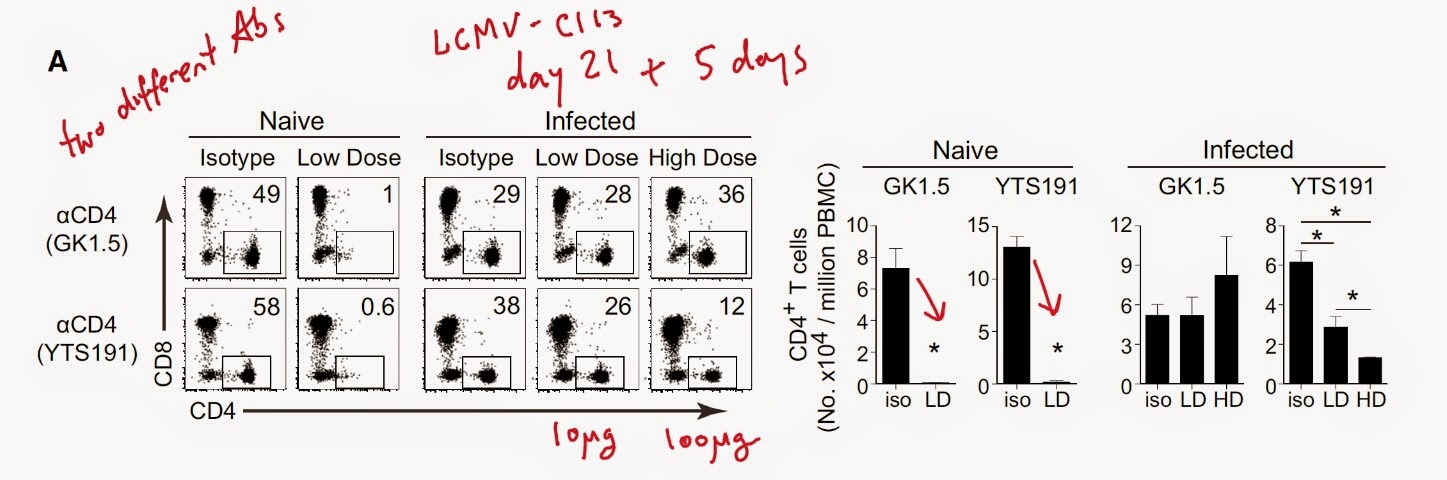
The authors (First author Douglas H. Yamada) observed that antibody-mediated depletion of target cell population was severely impaired in chronic LCMV-infected mice (LCMV-Clone 13).


Similar impairment was observed with LCMV-Clone 13 infected mice that receive human CD20 expressing tumor cell line (hCD20-EG7) and depleting α-CD20 antibody (Rituximab).


The authors observed that impairment of antibody-depleting function were selectively impaired in mice infected with LCMV virus producing persistent infection (LCMV-Clone 13), but not with LCMV virus producing acute infection (LCMV-Armstrong).


Additionally, the authors found that the presence of endogenous antibodies were necessary to impair depleting function of exogenously administered antibody.


Adoptive transfer showed that target cells in chronically infected hosts remained susceptible to antibody depletion.  


Additionally, presence of endogenous immune complexes (ICs) but not of free antibodies correlated with depletion deficiency.


Mechanistically, the authors showed that deficiency of macrophage population could recapitulate antibody depleting functional impairment.    


Furthermore, the presence of excess ICs in chronically infected hosts impaired priming of antigen-specific CD8 T cells via defective dendritic cell acquired antigen-antibody complexes.


In summary, these results suggest that excessive production of circulatory ICs during persistent viral infections (HBV, HBC, HIV, etc) impairs antibody-dependent Fc-receptor function (clearance of infected target cells, priming of antigen-specific CD8 T cells). It appears that macrophage Fc-receptors are overwhelmed in the presence of excess circulatory ICs (almost identical research results were presented in the 2nd paper by Rafi Ahmed's lab).

This knowledge could help to better understand the limitations of vaccine efficacy in human populations with chronic viral infections.

David Usharauli