An article in Cell Host and Microbe (CHM) caught my attention. In proposed that dual TCR expressing T cells are responsible for autoimmune phenotype in K/BxN mice.
K/BxN mice develop spontaneous arthritis thought to driven by Vβ6+ KRN T cells recognizing glucose-6-phosphate isomerase (GPI), the self-Ag presented by MHC class II Ag7 molecules. Ordinarily, it is thought that pathogen cross-reactive to self antigen, in this case GPI, could initiate autoimmune disease (theory of molecular mimicry).
However, recently the role of endogenous microbiota in driving autoimmune arthritis received new attention. Here, the authors showed segmented filamentous bacteria (SFB) was required to initiate autoimmune arthritis in K/BxN.

However, since SFB-derived peptide recognized by T cells required Vβ14+ TCR it was unclear how SFB was mediating autoimmunity against GPI recognized by completely different TCR made of Vβ6+ chain. Further analysis showed that some T cells in K/BxN express dual TCRs expressing both Vβ6+ and Vβ14+ chains. Indeed, sorted T cells expressing dual TCR, but not Vβ6+ chain alone, recognized SFB-derived peptide (A6).

In vivo, adoptive transfer of monoclonal KRN T cell population on RAG KO background that prevents expression of other Vβ or Vα chains (only expressing Vβ6+ KRN T cells), could not mediate arthritis in T cell-deficient host (harbor normal B cells also required for arthritis development). Of note, other paper in 1999 however found no difference in arthritis development between WT and RAG KO KRN T cells.

In summary, the authors think that first dual TCR T cells get activated by SFB-derived epitope via Vβ14+ TCR, indirectly prime Vβ6+ TCRs, on the same T cells, that then actually mediates autoimmunity against self antigen GPI. However, it is not clear from this study whether endogenous Vα chains could contribute to cross-reactivity between SFB and GPI when recombined with Vβ6+ or Vβ14+ chains in WT KRN T cells.
posted by David Usharauli
However, recently the role of endogenous microbiota in driving autoimmune arthritis received new attention. Here, the authors showed segmented filamentous bacteria (SFB) was required to initiate autoimmune arthritis in K/BxN.

However, since SFB-derived peptide recognized by T cells required Vβ14+ TCR it was unclear how SFB was mediating autoimmunity against GPI recognized by completely different TCR made of Vβ6+ chain. Further analysis showed that some T cells in K/BxN express dual TCRs expressing both Vβ6+ and Vβ14+ chains. Indeed, sorted T cells expressing dual TCR, but not Vβ6+ chain alone, recognized SFB-derived peptide (A6).

In vivo, adoptive transfer of monoclonal KRN T cell population on RAG KO background that prevents expression of other Vβ or Vα chains (only expressing Vβ6+ KRN T cells), could not mediate arthritis in T cell-deficient host (harbor normal B cells also required for arthritis development). Of note, other paper in 1999 however found no difference in arthritis development between WT and RAG KO KRN T cells.
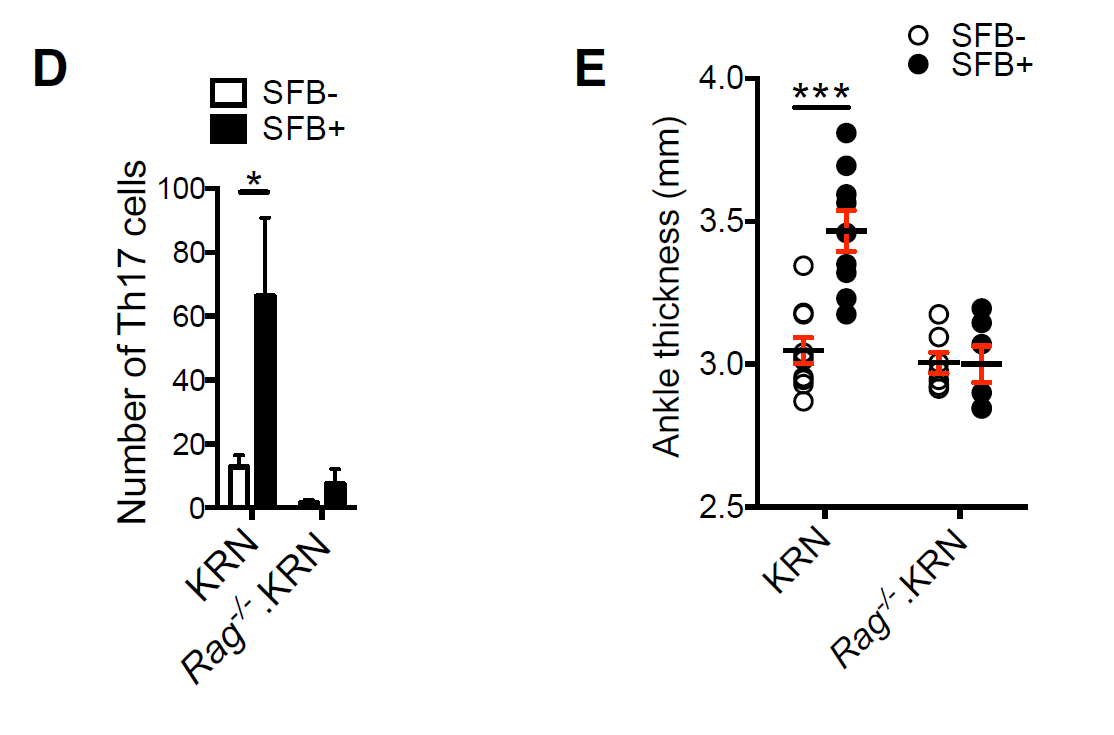
In summary, the authors think that first dual TCR T cells get activated by SFB-derived epitope via Vβ14+ TCR, indirectly prime Vβ6+ TCRs, on the same T cells, that then actually mediates autoimmunity against self antigen GPI. However, it is not clear from this study whether endogenous Vα chains could contribute to cross-reactivity between SFB and GPI when recombined with Vβ6+ or Vβ14+ chains in WT KRN T cells.
posted by David Usharauli


