Humanized therapeutic monoclonal antibodies play substantial role in cancer immunotherapy. For example, one of the most recognized member of this class is Rituximab (Rituxan), a humanized α-human CD20 monoclonal antibody used for treatment of B cell-derived malignancies.
It is thought that in humans their anti-cancer effects are mainly driven via human Fcγ receptor IIIA (FcγRIIIA)-mediated ADCC (antibody-dependent cellular cytotoxicity).
New study in journal Cell from Jeffrey Ravetch lab provided new evidence that α-human CD20 monoclonal antibody have two distinct anti-cancer effects: one, short term, via FcγRIIIA-mediated ADCC, and second, long-term, via FcγRIIA-mediated anti-cancer T cell priming.
Of note, the article has only one first author and one senior author.
Initially, the authors confirmed that presence of Fcγ receptors are necessary for anti-cancer effect of α-human CD20 monoclonal antibody.

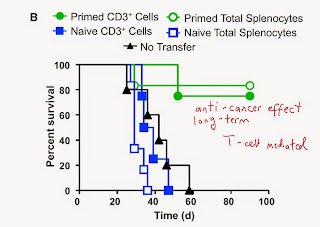
Next, the authors showed that wild-type mice treated with α-human CD20 monoclonal antibody and challenged with tumor cells expressing hCD20 antigen became "immune" to secondary challenge of hCD20 antigen expressing cancer cells, implying long-term memory development.

The authors showed that this anti-cancer memory was mediated by T cells generated after primary cancer challenge.
Using mice model with selective expression of human Fcγ receptors, the authors showed that primary anti-cancer effect of anti-human CD20 antibodies was restricted to antibody preferentially binding human Fcγ receptor IIIA, thus activating [macrophage]-mediated ADCC pathway.

The authors confirmed this observation with mice transgenic model expressing only human FcγRIIIA.

Conversely, the authors showed that long-term T cell mediated anti-cancer effect of anti-CD20 treatment was driven by FcγRIIA receptors.

In summary, these results provided new evidence how to improve effectiveness of anti-cancer therapeutic antibodies (it appears that commercial antibodies available on the market today target mainly FcγRIIIA, i.e. ADCC pathway). These results also reinforces the idea that successful cancer protection would require activation of several immune pathways (ADCC and T cell priming).
David Usharauli
It is thought that in humans their anti-cancer effects are mainly driven via human Fcγ receptor IIIA (FcγRIIIA)-mediated ADCC (antibody-dependent cellular cytotoxicity).
New study in journal Cell from Jeffrey Ravetch lab provided new evidence that α-human CD20 monoclonal antibody have two distinct anti-cancer effects: one, short term, via FcγRIIIA-mediated ADCC, and second, long-term, via FcγRIIA-mediated anti-cancer T cell priming.
Of note, the article has only one first author and one senior author.
Initially, the authors confirmed that presence of Fcγ receptors are necessary for anti-cancer effect of α-human CD20 monoclonal antibody.

Next, the authors showed that wild-type mice treated with α-human CD20 monoclonal antibody and challenged with tumor cells expressing hCD20 antigen became "immune" to secondary challenge of hCD20 antigen expressing cancer cells, implying long-term memory development.

The authors showed that this anti-cancer memory was mediated by T cells generated after primary cancer challenge.

Using mice model with selective expression of human Fcγ receptors, the authors showed that primary anti-cancer effect of anti-human CD20 antibodies was restricted to antibody preferentially binding human Fcγ receptor IIIA, thus activating [macrophage]-mediated ADCC pathway.

The authors confirmed this observation with mice transgenic model expressing only human FcγRIIIA.

Conversely, the authors showed that long-term T cell mediated anti-cancer effect of anti-CD20 treatment was driven by FcγRIIA receptors.

In summary, these results provided new evidence how to improve effectiveness of anti-cancer therapeutic antibodies (it appears that commercial antibodies available on the market today target mainly FcγRIIIA, i.e. ADCC pathway). These results also reinforces the idea that successful cancer protection would require activation of several immune pathways (ADCC and T cell priming).
David Usharauli

.png)
.png)
.png)
.png)


