This week journal Immunity published new study that revealed existence of hybrid innate cells expressing both NK and B cell markers (NK1.1+CD19+IgM+). The authors called it NKB cells.
By screening for NK1.1+ cell population in different tissues, the authors noticed that spleen and mLNs [but not other tissues] contained cell population expressing CD19 and IgM, a canonical B cell markers.

Image flow analysis confirmed that both NK1.1 and CD19 markers were expressed by the same cells.

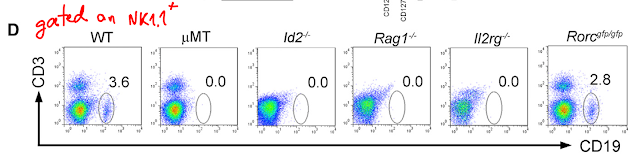
This new NKB cell population were absent in RAG-KO, IL-2RgcKO, B cell or NK-deficient mice, suggesting unique lineage (its precursors appear to express CD122, IL-2Rbeta chain).
In vitro functional analysis showed that NKB cells were innate producers of IL-18 and IL-12 (IL-12p40, most likely). Of note, NKB cells did not secrete antibody after stimulation.

In an in vivo infection model NKB cell-deficient mice (created by reconstituting lethally irradiated mice with Id2 and mMT deficient bone marrow cells) showed high susceptibility to L.M. infection.

Finally, the authors showed that IL-18 produced by wt NKB cells played important role in disease resistance against L.M. infection.

In summary, this study identified new type of innate cells expressing NK and B cell markers, called NKB cells, that were involved in early IL-18 production that contributed early waves of IFN-gamma from NK and ILC1 cells and resistance to L.M. infection. It is not clear what roles surface CD19 or IgM play in NKB cell functionality.
David Usharauli

Image flow analysis confirmed that both NK1.1 and CD19 markers were expressed by the same cells.

This new NKB cell population were absent in RAG-KO, IL-2RgcKO, B cell or NK-deficient mice, suggesting unique lineage (its precursors appear to express CD122, IL-2Rbeta chain).

In vitro functional analysis showed that NKB cells were innate producers of IL-18 and IL-12 (IL-12p40, most likely). Of note, NKB cells did not secrete antibody after stimulation.

In an in vivo infection model NKB cell-deficient mice (created by reconstituting lethally irradiated mice with Id2 and mMT deficient bone marrow cells) showed high susceptibility to L.M. infection.

Finally, the authors showed that IL-18 produced by wt NKB cells played important role in disease resistance against L.M. infection.

In summary, this study identified new type of innate cells expressing NK and B cell markers, called NKB cells, that were involved in early IL-18 production that contributed early waves of IFN-gamma from NK and ILC1 cells and resistance to L.M. infection. It is not clear what roles surface CD19 or IgM play in NKB cell functionality.
David Usharauli


